
Lead is the cheapest material on your roof and the most expensive one to get wrong, because a badly fixed flashing splits and puts water into the wall for years before anyone spots it.
The Short Version
- Milled sheet lead worked to Lead Sheet Association guidance, with proper bay lengths, chases and lead wedges.
- Lead-welded back gutters, corners and outlets, dressed cold where the tile profile calls for it.
- Free survey, drone view where it helps, then one honest fixed price in writing.
- A 25-year written workmanship guarantee on flashing repairs as well as full replacements.
Wey Valley Roofing is family-run, fully insured with Public Liability Insurance, and Scott has spent more than 36 years on Surrey roofs and still answers the phone himself, whether you need one flashing rewedged or the full range of roofer services Knaphill homeowners call us for.
Call 07428 300474 any time and a real person will answer, day, night or weekend.
Leadwork is the part of a roof that fails first when it is fitted badly, because lead moves with the weather and anything that stops it moving will split it.
Call Wey Valley Roofing on 07428 300474 for lead work & flashing in Knaphill, from a single split bay of chimney flashing to a full lead bay roof, surveyed free and priced in writing.
Quick Quote OnlineCall Now: 07428 300474Call Scott — 24/7 Emergency07428 300474
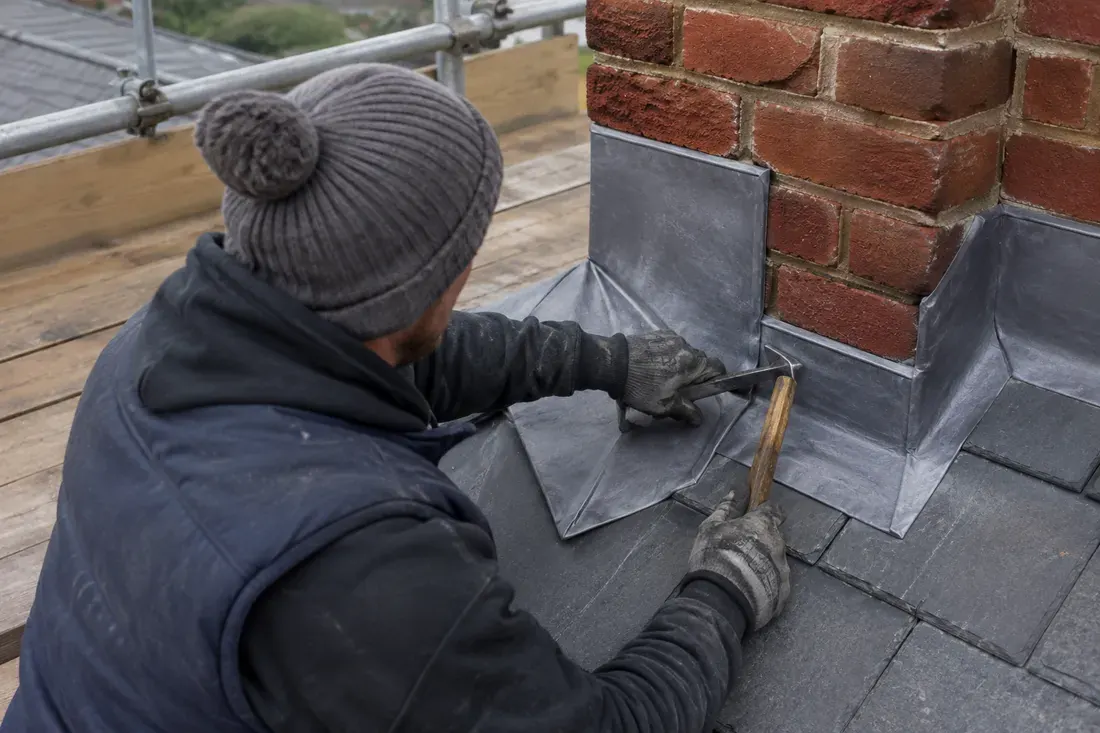
Lead Roofing Installation
On most Knaphill houses the lead is doing quiet work at the junctions: a chimney back gutter, a valley, an abutment where a rear extension meets the main wall. Code 4 milled lead suits most soakers and flashings, with Code 5 where a bay roof or a porch takes standing water and foot traffic. Bay sizes matter as much as thickness. Lead cut too long, fixed too tight, or laid over a bare timber deck without an underlay to let it slide will fatigue along a straight line and crack there.
We set out to Lead Sheet Association guidance, which covers bay lengths, welt and drip details, expansion allowance and the fixing pattern. Fixings are copper or stainless clout nails, never galvanised, and clips are folded so the lead is held rather than pinned. Where the lead sits on a deck it gets a separating layer and ventilation is considered under BS 5250 so the timber underneath stays dry. Detailing done right lasts decades.
Materials, Craftsmanship and Compliance for Knaphill Homes
Sand-cement fillets are the commonest thing we take off a roof around here. They look like flashing, they crack within a couple of winters, and the water goes straight down the wall behind them. Mortar is not a substitute for lead, and lead-effect tapes stuck over an old joint are a repair with a short life.
What goes on your roof is milled sheet lead to BS EN 12588, cut on site to suit the actual brick courses rather than a standard length. Chases are cut properly, not scratched, and pointed with lead wedges and a mortar mix that suits the wall. Tiling and slating around the new lead is reinstated to BS 5534 for fixing and wind uplift, and where we are working on abutments to a flat roof, BS 6229 governs the falls and the upstand heights. Rainwater sizing follows BS EN 12056 when a valley or a back gutter feeds a gutter that was already undersized.
- Milled sheet lead in the code the detail needs, not the code that is cheapest to buy
- Copper or stainless fixings, lead wedges, breather membrane and separating layers as required
- Old mortar fillets and tape repairs stripped out rather than covered over
- Stripped lead taken away for recycling, and the site swept before we leave
- A 25-year written workmanship guarantee handed over before the team goes, repairs included
Scott has spent more than 36 years on Surrey roofs and still answers the phone himself. That is the reason we quote a fixed price in writing after looking at the roof, and the reason the survey costs nothing. You are not paying for a guess, and you are not paying a middleman: the leadwork is done by our own roofers, not passed to a subcontractor we have never met. If a section of flashing can be dressed back and rewedged, we say so instead of writing up a full replacement.
Lead Welding and Detailing for Knaphill Homes
Lead-welded corners are the difference between a chimney back gutter that runs for forty years and one that weeps into the ceiling below. Soldered or folded-and-hoped corners open up. Lead welding fuses the sheet with lead filler, so the seam is the same metal and moves at the same rate as everything around it.
Typical welded details on a house of this sort include back gutter corners, hopper outlets, box gutter angles, dormer cheek junctions and the ends of a bay roof apron. Stepped and cover flashings are usually best worked cold, dressed to the tile profile with a dresser and a bossing stick so the lead follows the roll or the pantile rather than bridging it. Chimney work gets front aprons, stepped side flashings, soakers and a back gutter as separate pieces, each free to move. One sheet wrapped round a stack is a leak waiting to happen.
Leadwork for Heritage and Listed Buildings
Older Surrey properties often carry handmade clay peg tiles, soft red brick and lime mortar, and all three punish a modern short cut. Cutting a deep chase into soft brick with a disc, or repointing lead with a hard cement mix, does more harm than the original leak did.
On heritage and conservation work we match the existing detailing: the same code of lead, the same bay lengths, the same welt or lap the building already used, and lime-based pointing where the wall calls for it. Where a listed building or a conservation area is involved, consent sits with the local authority and we work to what has been agreed rather than around it. If you are searching for someone to look at old leadwork close to home in Knaphill, we can get out to see it and tell you honestly whether it needs replacing or dressing back.
Lead Roof Replacement and Restoration
Lead rarely fails all over. It fails at one bay, one corner, one joint that was fixed too rigidly, and the boards below tell you how long that has been going on. Any replacement starts with the timber, because new lead over rotten deck is money thrown away.
Whether you need lead work & flashing in Knaphill or chimney work in Knaphill, we cover the whole area, and the two jobs often turn up together on the same survey.
Step one, the call
Ring any time and a real person answers, day, night or weekend. Emergencies go to the front of the queue.
Step two, the survey
We inspect the leadwork properly, lift a tile or two where needed, check the deck and the ceiling below, and use a drone view where the pitch or the height makes it sensible. No charge and no obligation.
Step three, the fixed price in writing
You get the code of lead, the details to be replaced, the timber work and the tiling reinstatement listed out at one honest price. If a smaller repair will do, we say so.
Step four, the work and the guarantee
Our own roofers strip, re-board where required, form and dress the new lead, reinstate the roof covering, clear the site and hand over the 25-year written guarantee.
Restoration beats replacement more often than people expect.
Lead Flashing Repairs
A stain on a chimney breast, a damp patch at the top of an extension wall, a drip that only shows in driving rain: those are flashing symptoms, and the cause is nearly always one of a short list. Lead pulled out of the chase because the wedges were never fitted. A split across a bay that was cut too long. A fillet of mortar covering a joint that has no lead behind it at all. Thermal movement working a rigid fixing loose over years.
Repairs we carry out regularly include rewedging and repointing lifted flashings, replacing a single split bay, forming a new back gutter behind a stack, renewing soakers on a stepped abutment, and cutting a proper chase where someone previously relied on mortar. Where the tiling has been broken during an earlier attempt, we replace the tiles as part of the job rather than leaving you to find a tiler. With our own roofers working across Woking, Guildford and the Wey Valley, someone can usually be with you quickly when water is getting in.
Service Areas and Property Types
Knaphill roofs are a mixed bag: interwar semis with cement fillets at the extension abutment, newer estate houses with dry verges and thin flashings, cottages with peg tiles and tall stacks, plus garages and porches where a small lead apron has been ignored for decades.
We work across Knaphill and the surrounding villages, and out through Woking, Guildford, Cranleigh and the towns of Surrey and the Wey Valley. Property types we handle include:
- Terraces and semis with chimney flashings, soakers and back gutters
- Extensions and conservatories needing stepped and cover flashings at the abutment
- Bay roofs, porches and dormers in Code 5 lead
- Period and listed properties needing detailing matched to what is there
- Garages, outbuildings and parapet gutters
Where an old garage roof is asbestos cement, we assess it and advise the safe compliant route under the Control of Asbestos Regulations 2012 rather than disturbing it.
Request a Survey or Estimate
Most leadwork enquiries start with a ceiling stain and a guess about what is behind it. A survey settles it. We look at the actual detail, tell you which bays are sound and which are not, and put the answer in writing at a fixed price with nothing to pay for the visit. Where building control approval is relevant to associated work, GOV.UK guidance on building regulations approval sets out when it applies, and we will tell you plainly if your job reaches that point.
Call Scott on 07428 300474 and speak to someone who has been doing this on Surrey roofs for over 36 years. One visit, one price, one guarantee in writing.
Call Wey Valley Roofing on 07428 300474 for lead work & flashing in Knaphill, from a single split bay of chimney flashing to a full lead bay roof, surveyed free and priced in writing.
Quick Quote OnlineCall Now: 07428 300474Call Scott — 24/7 Emergency07428 300474