
Three coverings, one decision, and it is not really about the covering at all.
Key Points
- EPDM rubber is a single flexible sheet with almost no joints.
- GRP fibreglass cures rigid and seamless, so the deck beneath must be right.
- Felt means built-up torch-on layers, repairable and tougher than its reputation.
- Falls, fixings, upstands and ventilation decide the lifespan more than the material.
Family-run, fully insured, with a 25-year written workmanship guarantee on every job, and if you need flat roofing or flat roofing services Godalming, we cover the whole area.
Call Scott on 07428 300474 for a free survey and an honest fixed price in writing.
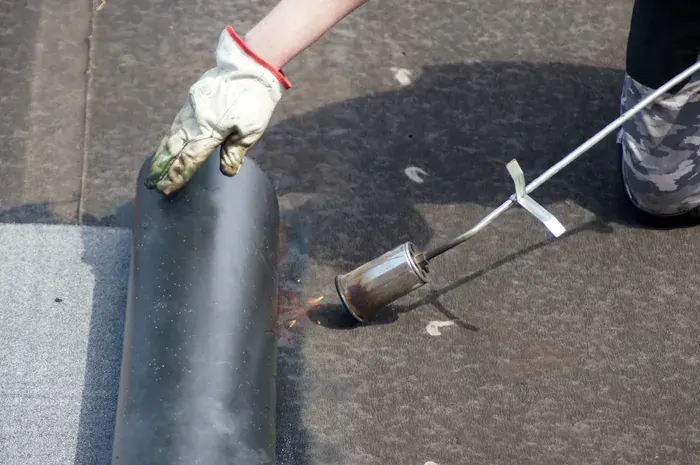
What are the three types of flat roofs?
The three types of flat roof in common domestic use are EPDM rubber, GRP fibreglass and felt, meaning torch-on or built-up bitumen sheet. They differ in how they are laid and how they behave over time, but all three need the same thing underneath: falls, fixings and ventilation done properly.
Everything else people call a flat roof type is really a variation on those three, or a detail of how the deck below is built. Single ply, liquid systems and hybrid membranes exist, but on a house extension, a dormer, a porch or a garage in Surrey and the Wey Valley, you are almost always choosing between rubber, fibreglass and felt. What follows is what each one actually is, where each one earns its place, and the part of the job that matters more than the covering itself.
Not sure whether your flat roof needs rubber, fibreglass or felt? Call Scott on 07428 300474 and book a free survey with a fixed price in writing.
Quick Quote OnlineCall Now: 07428 300474Call Scott — 24/7 Emergency07428 300474
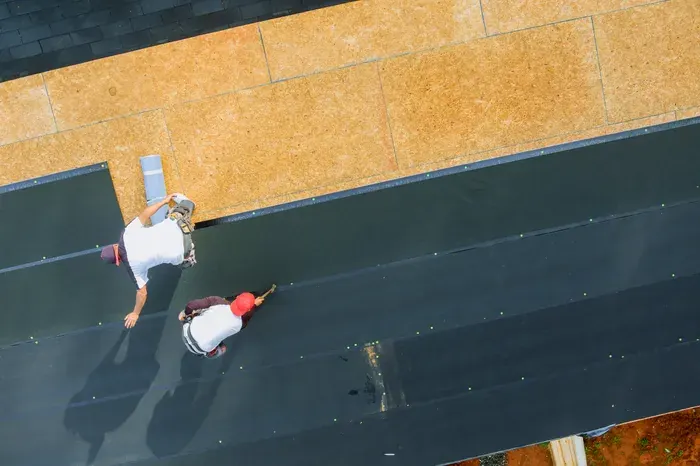
EPDM rubber is a single sheet with almost no joints
EPDM is a synthetic rubber membrane, bonded down as one continuous sheet over a prepared deck. On most domestic roofs the whole covering comes off a single piece, so there is nothing to split apart, no seam running across the middle of the roof waiting to open up. Trims and outlets are the only detail work.
It stays flexible. That is the honest reason it suits British weather: the sheet moves with the deck when the timber swells in November and shrinks in July, rather than fighting it and cracking. It handles UV without going brittle and it does not need heat to install, which matters on a roof tight against a neighbour's boundary or a timber fascia.
Where it is less suited is heavy foot traffic and anywhere the surface will be walked on regularly, unless it is protected. It is also unforgiving of a bad deck. A sheet membrane will follow every ripple and hollow in the boards below, so if the deck is tired, the deck gets replaced first. If you need flat roofing or flat roofing in Guildford, we cover the whole area, and the first thing we do either way is get up there and look at what the covering is sitting on.
GRP fibreglass cures into one solid, rigid surface
GRP is glass reinforced plastic. Chopped strand matting is laid over the deck and saturated with resin, then finished with a pigmented topcoat. It cures hard, so the finished roof is a single seamless shell rather than a sheet lying on top of one. Detailing at upstands, gutters and kerbs is formed in the same material, which is why it looks so tidy on a balcony or a dormer cheek.
The rigidity is the trade-off. GRP does not move much, so the deck under it has to be right: correct board type, correct fixing, correct thickness, no bounce. Put fibreglass over a deck that flexes and the resin will eventually crack at the point of movement. Done on a properly built deck it is tough, walkable and takes a balcony surface or a small terrace without complaint.
It also needs a dry, reasonably warm window to install, because resin cures to a chemistry that does not care about your schedule. Rushing a GRP roof in poor weather is how you get pinholes and delamination. If you want flat roofing or flat roofing services Woking, we cover the whole area, and we will say plainly when the weather means the job waits a week.
Felt means torch-on and built-up bitumen, laid in layers
Felt has a poor reputation earned by thin, single-layer work laid decades ago. Modern torch-on is not that. It is a built-up system, usually two or three layers of polyester reinforced bitumen sheet, each one bonded to the last, with a mineral finish on top. Laps are sealed with heat and the detailing at upstands is dressed in by hand.
It is genuinely robust. Multiple layers mean multiple chances for the roof to keep water out, and a damaged area can be patched into the existing build-up rather than the whole roof coming off. On large garage roofs and long low extensions it is often the sensible choice, and it takes a fall and a drainage layout without fuss.
We treat felt as one of three systems inside our flat roofing services, not as a lesser option wheeled out when a budget is tight. It has its place, and the place is not always the cheap one. Torch-on does mean naked flame on site, so it needs proper hot works discipline and it is not the right answer everywhere, particularly close to timber cladding or a thatched neighbour.
Not sure whether your flat roof needs rubber, fibreglass or felt? Call Scott on 07428 300474 and book a free survey with a fixed price in writing.
Quick Quote OnlineCall Now: 07428 300474Call Scott — 24/7 Emergency07428 300474
The covering matters less than the deck, the falls and the ventilation
Every flat roof that fails early fails for one of four reasons, and the choice of membrane is rarely one of them. Water sitting still because the falls were never set. A cold deck with no ventilation path, so condensation forms inside the build-up and rots the timber from within. Fixings that were never specified for the wind loading. Or upstands and flashings taken too low, so water finds the gap at the wall.
We work to BS 6229 on flat roofs, BS 5250 for ventilation and condensation control, BS 5534 for fixing and wind uplift, and BS EN 12056 for sizing the rainwater outlets. That is not a badge, it is just the arithmetic that decides whether a roof lasts twenty years or five. Where the existing build-up is cold and damp, a warm roof upgrade puts the insulation above the deck and moves the dew point out of the timber, which is a bigger improvement than any change of membrane.
Under Approved Document L, replacing enough of a roof can trigger a requirement to upgrade the insulation, and we deal with that at survey stage and put it in the written price rather than raising it halfway through. Searching for a flat roofer near you and want someone who is already working on roofs a few miles away? Scott has spent more than 36 years on Surrey roofs and still answers the phone himself.
- EPDM for a seamless, flexible covering with minimal joints, on a sound deck.
- GRP for a rigid, walkable surface where the deck is built to take it.
- Felt for a layered, repairable system that suits larger and simpler roofs.
- All three live or die on falls, fixings, upstands and ventilation.
Every flat roof we lay carries a 25-year written workmanship guarantee, handed over before the team leaves, and if a repair will do the job we say so instead of selling you a new roof.
Not sure whether your flat roof needs rubber, fibreglass or felt? Call Scott on 07428 300474 and book a free survey with a fixed price in writing.
Quick Quote OnlineCall Now: 07428 300474Call Scott — 24/7 Emergency07428 300474