
You can buy lead by the roll almost anywhere. Getting it cut, dressed and chased in so it never leaks again is a different question entirely.
The Essentials
- Lead sheet is sold in codes, and the code is the thickness: Code 4 for most flashings, Code 5 and up for valleys and gutters.
- Roofing and builders' merchants stock it in rolls, but the sheet is only part of the job, patination oil, clips and wedges all matter.
- Almost every lead failure is a fitting failure: surface-mounted flashings, over-long pieces, missing clips or mortar used in place of lead.
- Lead prices track the metal market, so leadwork is quoted as a job with the material included rather than off a price list.
Wey Valley Roofing is family-run, works to Lead Sheet Association guidance on leadwork, and hands over a 25-year written workmanship guarantee on every job. Whether you need lead work & flashing or lead work & flashing services Godalming, we cover the whole area.
Call 07428 300474 and a real person answers, day, night or weekend.
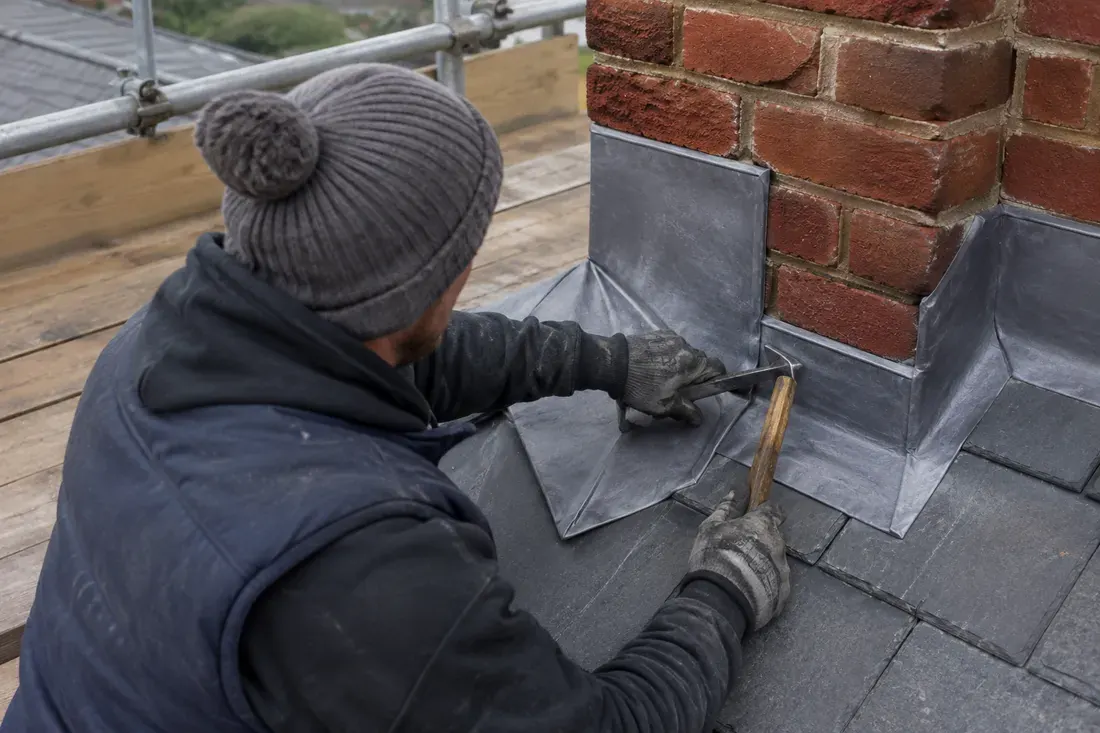
Where can I get lead flashing?
Lead flashing comes from builders' merchants and roofing suppliers, who sell it by the roll in standard codes, and from a roofer who buys, cuts and dresses it for you. Buying the sheet is the easy half. Getting it sized, welted and fixed so it stays watertight is the part that matters.
Need lead flashing sourced, cut and fitted properly? Call Wey Valley Roofing on 07428 300474 for a free survey and an honest fixed price in writing.
Quick Quote OnlineCall Now: 07428 300474Call Scott — 24/7 Emergency07428 300474
What you are actually buying when you buy lead
Milled lead sheet is sold in codes, and the code is just the thickness. Code 3 is the thinnest in common use, Code 4 is the everyday choice for most flashings and soakers, Code 5 goes on valleys, gutters and anywhere that gets walked on or takes standing water, and Code 6 turns up on larger bays and exposed detailing. Merchants stock it in 3m and 6m rolls in a range of widths, so the width you ask for should follow the detail you are covering rather than whatever happens to be on the rack.
The other thing you are buying is the ancillary kit that most people forget: patination oil to stop the white carbonate staining that runs down brickwork and render, lead wedges, a mortar or sealant for the chase, and the right clips at the free edges. Buy the sheet without those and you get a job that looks wrong within a month.
Whether you need lead work & flashing or lead work & flashing in Guildford, we cover the whole area, and we buy the sheet as part of the job rather than asking anyone to source it themselves.
Where the sheet gets bought in practice
Roofing merchants and the larger builders' merchants carry lead in stock and will cut a roll down. Independent lead specialists hold the heavier codes and the odd widths. Some online suppliers will deliver cut lengths, though lead is heavy, it marks easily in transit, and a kinked roll is harder to dress than a clean one. If you are hunting for a lead flashing supplier or a roofer near you, the practical answer is usually the trade counter your local roofers already use, because they know the codes that move and they will not sell you Code 3 for a valley.
Prices move with the metal market, which is why nobody quotes lead from a printed list. That also explains why lead gets stolen off roofs, and why a replacement flashing is often a repair job rather than a supply job.
Whether you need lead work & flashing or lead work & flashing in Woking, we cover the whole area, and the sheet, fixings and labour come as one written price.
Sourcing the sheet is not the same as fitting it
Lead moves. It expands and contracts every day the sun hits it, which is why lengths are limited, why laps are staggered, and why a long unbroken run cracks along the fold within a few winters. Lead Sheet Association guidance sets out the maximum piece lengths, the lap dimensions and the clip spacing for each code and each detail, and those numbers are the difference between a flashing that lasts fifty years and one that splits.
The common failures are all fitting failures, not material failures. Flashing sat on the surface of the brick with a bead of mastic instead of cut 25mm into a raked joint. Step flashings made as one long strip rather than individual pieces following the courses. Cover flashings dressed too tight over a tile roll so there is no room to move. Chimney back gutters made too shallow, with no upstand and no proper welted edge. Mortar fillets used where lead should be. None of those are cured by buying better sheet.
What we do with lead on Surrey roofs
Most of our lead work is chimneys, abutments, valleys, parapets, dormer cheeks and porch roofs, plus the flashings that get renewed as part of a reroof. Lead stolen or lifted by wind gets treated as an emergency, because the water is already coming in.
- Right code, right detail. Code 4 for most flashings, Code 5 upwards for valleys, gutters and anything trafficked.
- Chased in properly. Joints raked out, lead dressed in, wedged and repointed, not glued to the face of the brick.
- Sized for movement. Piece lengths, laps and clips to Lead Sheet Association guidance, with fixings to BS 5534 where wind uplift is a factor.
- Finished and written down. Patination oil applied, site cleared, and a 25-year written workmanship guarantee handed over before we leave.
Scott has spent more than 36 years on Surrey roofs and looks at the whole detail, not the one visible split. If a single step flashing is the problem, that is what we say, and that is what we price.
Need lead flashing sourced, cut and fitted properly? Call Wey Valley Roofing on 07428 300474 for a free survey and an honest fixed price in writing.
Quick Quote OnlineCall Now: 07428 300474Call Scott — 24/7 Emergency07428 300474